PSA vs. BGS vs. CGC vs. SGC: Which Grading Company Should You Use?
How the four big card grading companies differ in scales, labels, resale value, and which one fits sports cards vs. Pokémon.
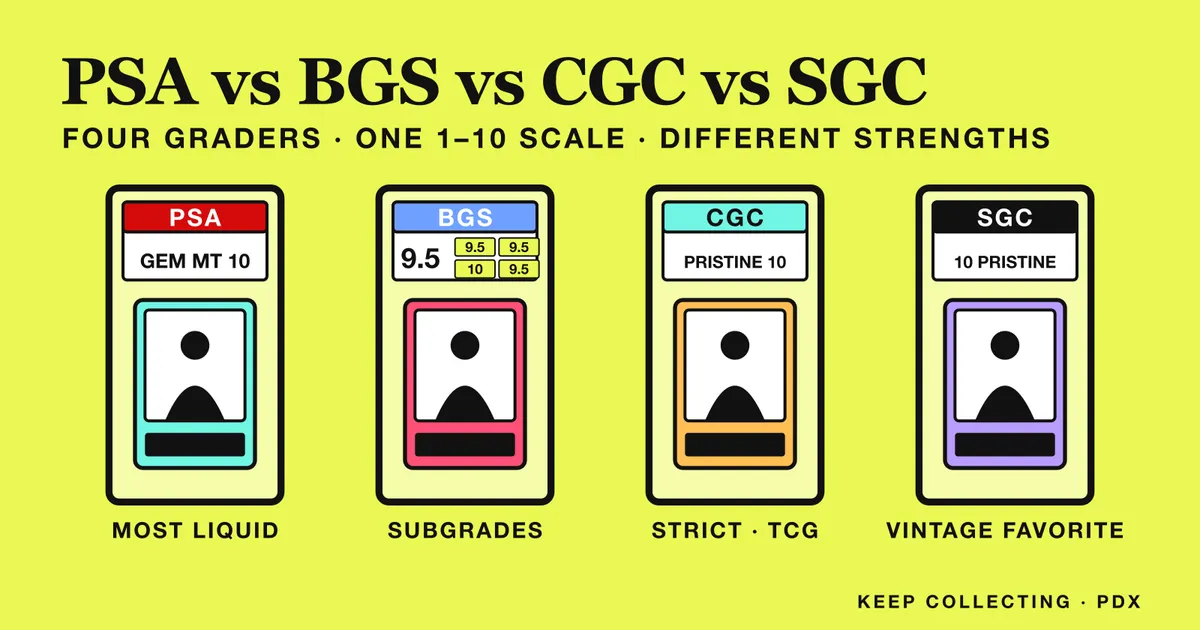
Grading turns a raw card into a sealed, authenticated slab with a number on it, and that number can multiply a card’s value. But the company on the label matters almost as much as the grade. Here’s how the big four compare and how to choose.
The short version
- PSA: the default for most sports cards and Pokémon. Usually the strongest resale value, especially for PSA 10s.
- BGS (Beckett): known for subgrades and the rare Black Label. Popular for modern sports cards.
- CGC: a big player in Pokémon and other TCGs, with detailed labels and a reputation for strict grading.
- SGC: the classic “tuxedo” black label. Loved for vintage sports cards and often fast.
How grading works
Every company inspects four things: centering, corners, edges, and surface. It checks the card is authentic, assigns a grade (almost always on a 1–10 scale), and seals it in a tamper-evident plastic holder.
The differences come down to how strict each grader is, what the label shows, and how buyers value that company’s slabs.
PSA (Professional Sports Authenticator)
PSA is the largest grading company and the one most buyers look for first.
- Scale: 1–10, with a single overall grade (no subgrades).
- Strength: liquidity. PSA slabs are the easiest to sell, and PSA 10s often command the biggest premiums in both sports and Pokémon.
- Watch out for: turnaround times and prices vary a lot by service level and demand. Check the current tiers before you submit.
Best for: cards you plan to sell, and high-demand modern or vintage cards where a PSA 10 is the target.
BGS (Beckett Grading Services)
Beckett gives four subgrades (centering, corners, edges, surface) plus an overall grade.
- Pristine 10 and Black Label: a BGS 10 with all four subgrades at 10 gets the Black Label, one of the rarest and most valuable designations in the hobby.
- BGS 9.5 (Gem Mint) is widely treated as roughly comparable to a PSA 10 by many buyers, though pricing varies by card.
Best for: modern sports cards, and collectors who want to see exactly why a card got its grade.
CGC (Certified Guaranty Company)
CGC started in comics and became a major name in trading card games.
- Labels: CGC separates a Pristine 10 from a Gem Mint 10, and offers subgrades as an option.
- Reputation: often considered strict, which makes its top grades meaningful.
Best for: Pokémon and other TCG cards, especially if you like detailed labels.
SGC (Sportscard Guaranty)
SGC’s black “tuxedo” slab is a favorite for displaying vintage cards.
- Scale: 1–10, with a 10 Pristine above a 10 Gem Mint.
- Reputation: respected for vintage, and often quicker than the biggest graders.
Best for: vintage sports cards and collectors who care about display.
Side-by-side
| PSA | BGS | CGC | SGC | |
|---|---|---|---|---|
| Subgrades | No | Yes | Optional | No |
| Top designation | 10 Gem Mint | Black Label 10 | Pristine 10 | 10 Pristine |
| Strongest in | Sports + Pokémon resale | Modern sports | Pokémon / TCG | Vintage sports |
| Resale liquidity | Highest | High | Growing | Good |
How to choose
- Selling soon? Check recent sold listings for the exact card in each company’s slab. The market tells you which label pays best for that card.
- Keeping it? Pick the label you like looking at.
- Unsure of condition? A company with subgrades (BGS or CGC) tells you where the card lost points.
- Budget matters? Compare the current price tiers at each company. Grading a $20 card rarely makes sense unless you expect a 10.
Before you submit anything
Look at the card under bright light, front and back. Check the corners with a loupe, look for print lines and surface scratches, and measure the centering. Put anything worth grading in a penny sleeve and a semi-rigid holder. Our card storage guide covers exactly what to buy.