How to Store Trading Cards: From Penny Sleeves to Graded Slabs
A collector's guide to protecting sports and Pokémon cards: which sleeves, toploaders, binders, and boxes to use, and the mistakes that ruin cards.
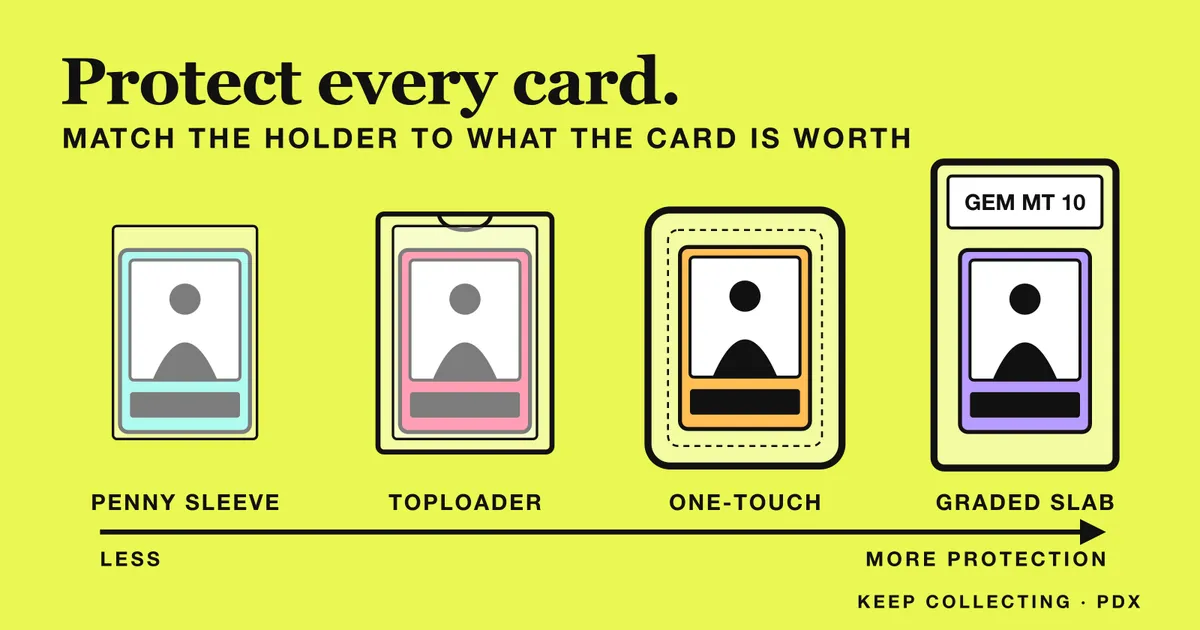
A card’s condition decides most of its value. The same card can sell for ten times more in gem-mint shape than with one soft corner, and most damage comes from bad storage, not from how the card was pulled. The good news: protecting cards properly is cheap.
Here’s the system most serious collectors use, matched to what each card is worth.
The quick answer
| Card value | How to store it |
|---|---|
| Bulk / commons | Row box, no sleeve needed |
| A few dollars | Penny sleeve → binder or row box |
| $20+ or grading candidates | Penny sleeve → toploader or semi-rigid holder |
| Display pieces | Penny sleeve → magnetic one-touch |
| Already graded | Slab → graded card box, stored upright |
Step 1: Penny sleeves (for every card you care about)
A penny sleeve is a thin, soft plastic sleeve. It’s the first layer between your card and everything else. Slide the card in top first so the corners don’t catch the sleeve’s edge.
Buy acid-free, PVC-free sleeves. PVC plastic breaks down over time and can leave a film on card surfaces.
Penny sleeves (acid-free, PVC-free)
Usually a few dollars per 100
Standard-size sleeves fit both sports cards and Pokémon cards.
- Dirt cheap
- Required under almost every other holder
- No rigidity on their own
Step 2: Toploaders or semi-rigids (for your hits)
A toploader is a rigid plastic holder. Sleeve the card first, then slide it in. Toploaders are the standard for shipping cards and storing anything with real value.
A semi-rigid holder (often sold as “Card Savers”) is thinner and a bit flexible. PSA and several other graders prefer submissions in semi-rigids because they’re easier to get cards out of without damage. If you plan to grade a card, put it in a semi-rigid.
Standard 3x4 toploaders (35pt)
35pt fits standard base cards. Thick patch and relic cards need a thicker size, so check the card’s point thickness.
- Rigid protection
- Stack neatly in storage boxes
- Card can slide out if not sleeved and sealed
Step 3: Magnetic one-touch holders (for display)
One-touches are two-piece magnetic cases that sandwich the card. They look great on a shelf and have UV protection options. Match the holder’s point size to the card’s thickness. Too loose and the card rattles; too tight and you’ll bend it.
Binders: great, if you pick the right ones
Binders make it easy to flip through a set or a player collection. Two rules:
- Side-loading pages. Top-loading pockets let cards slide out when the binder is tipped.
- D-ring or zip binders, not O-ring. O-rings curve the pages near the spine and dent the cards closest to them.
Don’t overstuff pockets. One card per pocket (or two back-to-back, sleeved) is plenty.
Storing boxes long-term
- Stand cards upright in row boxes or toploader boxes. Don’t stack heavy boxes on top of each other.
- Keep them away from sunlight. UV fades ink and yellows sleeves.
- Control humidity. Basements and attics are the worst places for cards. A closet inside the living area is better. Silica gel packs in the box help.
- Don’t use rubber bands. They dent edges and break down into a sticky mess.
Mistakes that ruin cards
- Sliding an unsleeved card into a toploader (scratches the surface)
- Taping a toploader shut across the opening where the card slides in (use painter’s tape or a team bag instead)
- Handling cards with lotion or food on your hands
- Storing slabs flat in a pile, which scratches the plastic
Bottom line
Sleeve everything you care about, toploader or semi-rigid anything worth $20 or more, and keep boxes upright, dark, and dry. It costs a few cents per card and protects the value of your whole collection.